Understanding the top types of fish specimens begins with their purpose, not their appearance. A museum mount may display external form, while a wet specimen preserves delicate tissues in a clear, labeled jar. Skeletal preparations reveal vertebrae, jaws, and fin supports. Cleared-and-stained specimens can show cartilage and bone beneath the skin.
Each Fish Specimen requires different preparation, storage, and documentation. Taxidermists often focus on accurate body shape, scale placement, and natural coloration. Laboratory staff may prioritize tissue preservation, fluid stability, and protection from light. Teaching collections need specimens that remain useful after repeated handling. Research collections demand precise labels, collection dates, locations, and verified species names.
Details matter.
A poorly recorded specimen can lose much of its scientific value. Even experienced professionals may disagree about the best preservation method for unusual species. That uncertainty deserves careful review rather than confident guessing. Ethical sourcing also matters. Reputable collections use legally obtained material, follow animal welfare standards, and maintain transparent records.
This guide will compare common specimen types by appearance, educational value, durability, and practical care. It will also consider their limitations. A polished mount may look impressive but hide internal anatomy. A wet specimen may preserve structure better but require controlled temperature and fluid checks. Seeing these differences helps collectors, educators, and researchers choose responsibly. It also encourages a more honest view of specimen work: preservation is skilled, useful, and sometimes imperfect.
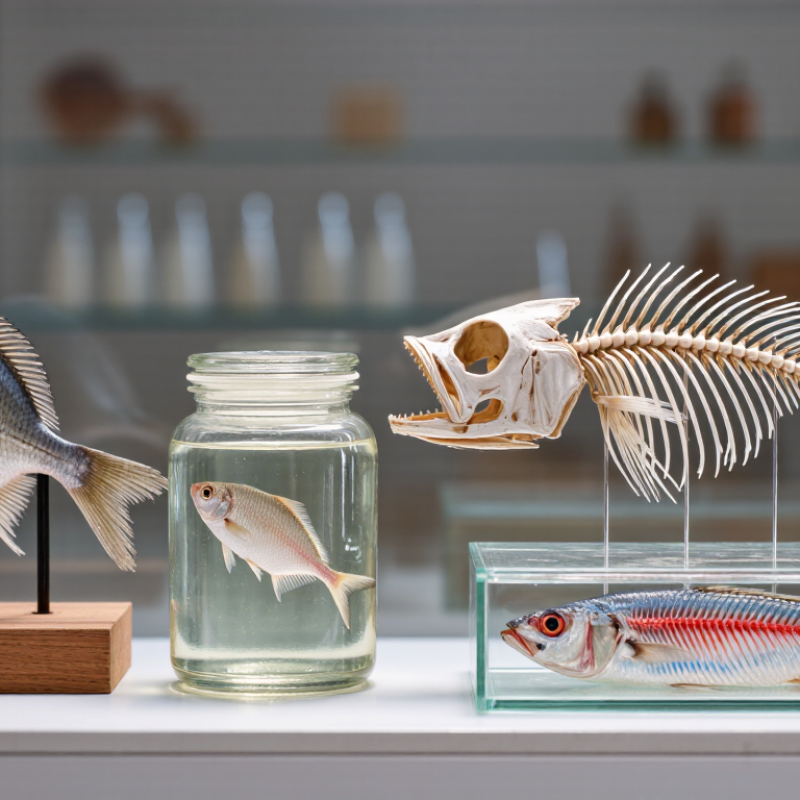
Whole-fish vouchers are among the most valuable specimens in ichthyology. They preserve body shape, fin placement, scale patterns, and stomach contents. These details support species identification and future taxonomic review.
The FAO reported 185 million tonnes of global aquatic animal production in 2022. Such production increases the need for reliable biodiversity records, especially when field identification is uncertain.
A practical voucher begins with clear photographs and collection data. Record location, date, habitat, collector, and field number before preservation. Small tissue samples should be removed before fixation when genetic testing is planned.
Place the fish in about ten times its volume of buffered 10% formalin. Make sure the solution reaches the body cavity and muscle. Large fish may need a small abdominal incision. Labels must remain readable and chemically stable.
After adequate fixation, rinse the specimen carefully. Transfer it to 70% ethanol for long-term storage. Ethanol reduces continued formalin exposure, but it can still evaporate. Check fluid levels during collection audits.
I have seen labels fade, lids loosen, and specimens lose diagnostic color. These failures are preventable, yet they still occur.
The IUCN Red List has assessed more than 44,000 species as threatened, making accurate vouchers increasingly important. A voucher is not merely a preserved fish. It is a verifiable data point for conservation, fisheries research, and later scientific correction.



Copyright © CUSTOM Building Products 2025
Products | Resources | Interactive Tools | Warranties | Privacy Policy | Terms of Use | Technical Training