Choosing the right Sport Floor begins with understanding how people will move, stop, fall, and recover inside the facility. A basketball court demands controlled ball response and reliable traction. A fitness studio needs shock absorption, quiet footfall, and easy cleaning. These requirements are not interchangeable.
Industry data shows why this decision deserves careful planning. The Sports & Fitness Industry Association reported 242.3 million Americans participated in at least one sport or fitness activity in 2023. The Global Wellness Institute valued the worldwide physical activity economy at approximately $1.1 trillion in 2022. More users mean more impact, cleaning cycles, and maintenance pressure. A floor may look premium on opening day. That proves very little. Its real quality appears after months of sprints, dropped equipment, and repeated disinfecting.
This guide compares Sport Floor options through performance, safety, durability, lifecycle cost, and installation conditions. It also considers recognized guidance, including ASTM F2772 for indoor sports flooring and EN 14904 for multi-sport surfaces. These standards help measure force reduction, vertical deformation, friction, and ball behavior. However, compliance alone does not guarantee the best result. A surface selected without checking subfloor moisture or drainage can fail early. I have seen attractive specifications become expensive compromises. The better approach combines test data, practical experience, and honest facility goals. Consider the athlete’s landing, the caretaker’s workload, and the owner’s long-term budget. The “best” floor is rarely the most expensive one. It is the one that performs consistently where your facility needs it most.
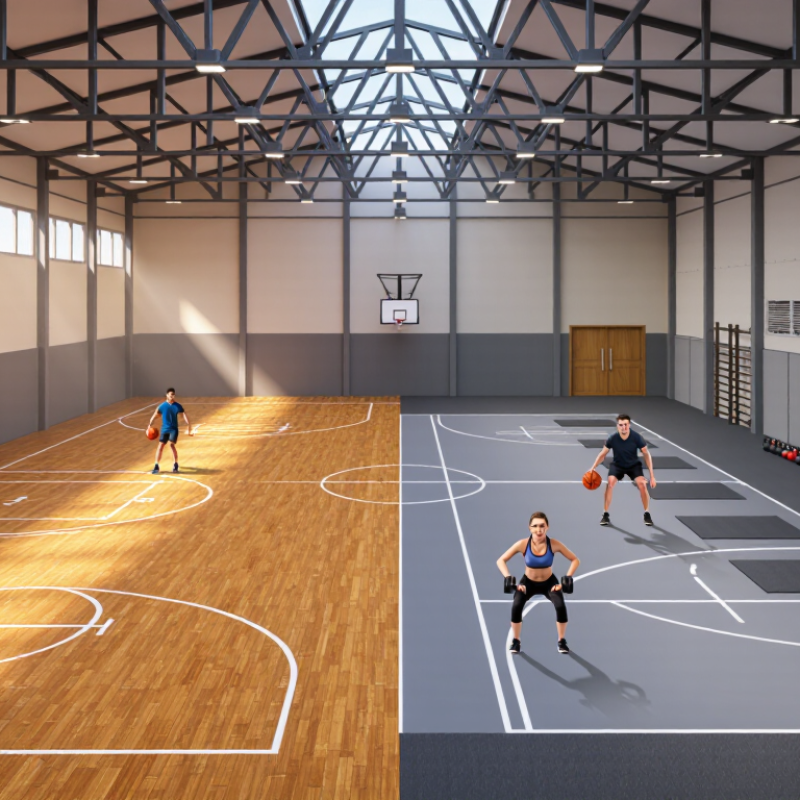
A sound floor decision starts with the facility, not the product. Record every activity, user group, and daily schedule. A school gym may host basketball, assemblies, and indoor walking. Each use creates different loading, traction, and maintenance demands. The WHO Global Status Report on Physical Activity 2022 estimates that 31% of adults worldwide do not meet recommended activity levels. This highlights the need for welcoming, adaptable exercise spaces.
Measure the room carefully. Note slab moisture, sunlight, ventilation, drainage, and existing cracks. Ask how quickly the floor must recover after heavy use. EN 14904 specifies 25% to 75% shock absorption for area-elastic sports surfaces. It also limits vertical deformation to 3.5 millimetres. These figures provide a technical reference, not an automatic answer. ASTM F2772 evaluates force reduction, vertical deformation, ball rebound, and area indentation. Use both performance data and site conditions.
My first specification was too simple. I focused on impact protection and overlooked cleaning time. That mistake can affect opening hours and operating costs. Consider athletes, children, wheelchair users, coaches, and maintenance staff. Test traction with suitable footwear, especially near entrances. Request independent laboratory results, installation tolerances, and maintenance records. A floor may perform well in a report, yet fail when moisture, poor subfloor preparation, or inconsistent cleaning enters the picture. Check those risks before approving the final specification.



Copyright © CUSTOM Building Products 2025
Products | Resources | Interactive Tools | Warranties | Privacy Policy | Terms of Use | Technical Training