Choosing the best Exterior Wood Sheet in 2026 requires more than comparing prices, thicknesses, or attractive grain patterns. Outdoor wood faces rain, sunlight, insects, wind, and repeated temperature changes. A sheet that performs well beneath a roof may fail quickly on an exposed wall. The right decision begins with the project’s moisture level, structural load, ventilation, and expected service life.
Joe Lstiburek, a respected building-science expert, has often stated, “Water is the enemy of buildings.” His warning applies directly to Exterior Wood Sheet selection. Look for documented water resistance, suitable bonding, stable core construction, and clear installation guidance. Check whether the panel is designed for exterior exposure, not merely temporary weather protection. Also inspect the edges. Small gaps, unsealed cuts, and trapped water can cause swelling before the surface appears damaged.
Real projects teach uncomfortable lessons. A premium panel can still fail when flashing is missing. A cheaper sheet may perform acceptably when protected by generous eaves and careful sealing. That makes product choice only one part of the result. Manufacturer test data, certification, warranty language, and installer experience deserve equal attention. Claims can sound convincing.
In 2026, compare engineered wood sheets by exposure rating, dimensional stability, surface durability, environmental documentation, and maintenance needs. Consider the local climate, too. Coastal air, heavy snow, and intense ultraviolet light create different risks. No option is perfect. The best Exterior Wood Sheet is the one matched honestly to the building, the weather, and the workmanship available.
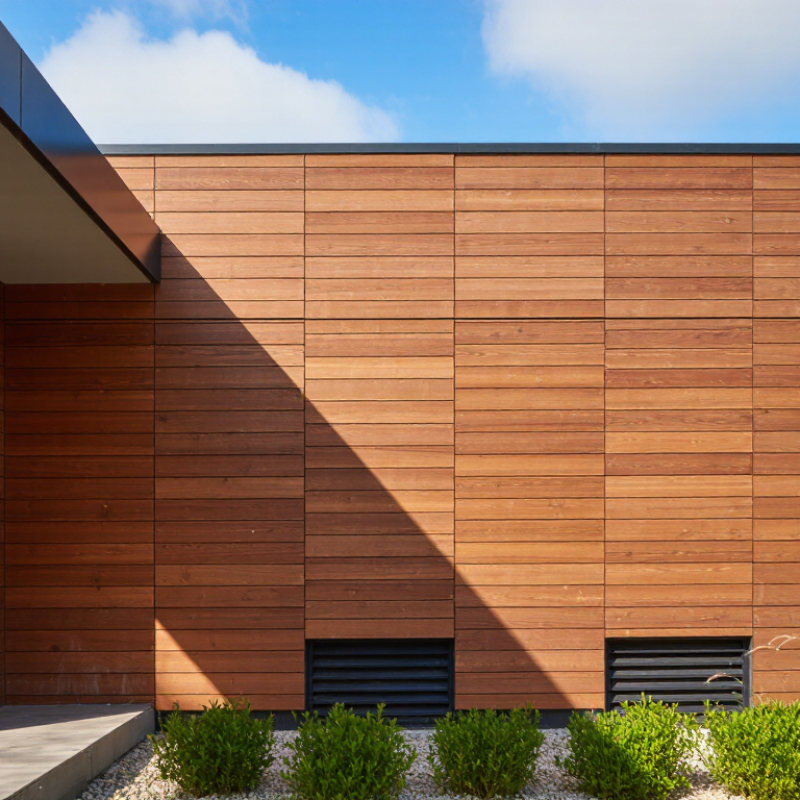
Choosing the best exterior wood sheet begins with identifying the sheet type, not the price. Exterior-grade plywood uses layered veneers, giving it good strength and relatively stable dimensions. It works well for wall cladding, soffits, and roof edges when properly sealed. However, exposed edges can absorb water quickly. I always inspect them before installation.
Oriented strand board, or OSB, is made from compressed wood strands and often offers consistent structural performance. It can be suitable for sheathing when its exposure rating matches the project. It is not permanently waterproof. Swollen edges reveal trouble. Treated plywood adds protection against decay, but treatment does not replace drainage, paint, or careful fastening. Marine-grade sheets resist water better, yet they may be unnecessary for ordinary exterior walls.
Core properties deserve close attention. Check thickness, panel span ratings, moisture resistance, surface quality, and edge condition. A 12-millimeter sheet may feel firm in a store but flex between widely spaced supports. That mistake is expensive. Leave the manufacturer’s recommended expansion gaps, especially in humid weather. Keep sheets raised above concrete, with airflow underneath. I have seen covered panels warp because “covered” was mistaken for “dry.” Inspect every panel for delamination, open knots, and crushed corners. One overlooked defect can become a visible failure after several rainy weeks.
| Exterior Wood Sheet Type | Relevant Classification or Standard | Typical Thickness | Core Properties | Moisture Performance | Structural Capability | Typical Exterior Applications | Important Limitations |
|---|---|---|---|---|---|---|---|
| Exterior Structural Plywood | EN 636-3 for exterior conditions; other regional structural plywood standards may apply | 9–25 mm | Cross-laminated veneers, good strength-to-weight ratio, relatively stable panels, clean cutting and fastening | Designed for exterior exposure when correctly manufactured and finished; exposed edges still require sealing | Suitable for many sheathing, bracing and panel applications when thickness, span and grade are correctly specified | Wall and roof sheathing, soffits, exterior cabinetry, doors and covered outdoor structures | Quality varies by veneer grade and face classification; it must not be assumed to resist insects or decay without preservative treatment |
| Marine Plywood | Often manufactured to marine plywood requirements such as BS 1088 or equivalent regional specifications | 6–25 mm | High-quality veneers, durable bonding, low core void content and good dimensional consistency | Very good resistance to repeated wetting when properly specified, sealed and maintained | Strong and stable, but design values must come from the product declaration or applicable structural standard | Boatbuilding, exposed joinery, high-quality outdoor furniture and demanding wet-area construction | Marine grade describes construction and bonding quality, not automatic resistance to termites, fungi or permanent immersion |
| Pressure-Treated Plywood | Must comply with the applicable treated-wood and structural plywood requirements in the installation region | 9–25 mm | Structural plywood with preservative chemicals introduced under pressure to improve biological durability | Better resistance to decay and insects than untreated panels, provided the treatment reaches the required retention and penetration | Can be structural if the untreated panel grade and treatment process are both approved for the intended use | Decking components, outdoor utility structures, landscaping, foundations and locations with increased decay risk | Cut edges and drilled areas may need field treatment; fasteners must be compatible with the preservative system |
| OSB/3 | EN 300, load-bearing boards for use in humid conditions | 9–22 mm | Engineered strands arranged in oriented layers; uniform panel structure and efficient material use | Suitable for humid service conditions, but not intended for unprotected, permanently wet exposure | Load-bearing in humid conditions when the declared span, thickness and edge-support requirements are followed | Roof decking, wall sheathing, floor substructure and protected exterior construction | Edges can swell after prolonged wetting; it requires adequate ventilation, drainage, joint gaps and weather protection |
| OSB/4 | EN 300, heavy-duty load-bearing boards for use in humid conditions | 12–25 mm | Higher mechanical performance than OSB/3, with oriented strands and strong directional properties | Performs in humid conditions but is not a substitute for a fully weatherproof exterior cladding system | High load-bearing capacity for demanding structural applications, subject to engineering design and product data | High-load roof and wall sheathing, platform floors and heavily loaded timber-frame assemblies | Usually heavier and more expensive than OSB/3; swelling and dimensional movement must still be controlled |
| Exterior-Grade MDF | Use only products specifically classified for exterior or severe-humidity service under the relevant local standard | 6–30 mm | Fine, smooth fiber surface; easy to machine, rout and paint; generally heavier than plywood | Special exterior formulations resist moisture better than standard MDF, but all faces and edges need a durable coating system | Generally non-structural unless a product is specifically tested and declared for structural use | Painted trim, signage, decorative panels, molded profiles and protected exterior furniture parts | Not suitable for structural sheathing by default; prolonged water exposure can still cause swelling and edge damage |
| Exterior-Grade Particleboard | Only use panels explicitly classified for exterior or severe-humidity conditions | 10–25 mm | Flat, economical engineered panel with relatively uniform surface and lower screw-holding performance than plywood | More vulnerable to edge swelling and loss of integrity than plywood when water enters the panel | Usually limited to non-structural or specifically engineered applications | Protected exterior cabinets, temporary installations and covered applications with complete surface sealing | Generally a poor choice for exposed cladding, wet ground contact or applications requiring high fastener strength |
Selection note: Always verify the panel’s declared service class, structural grade, thickness, formaldehyde class, preservative treatment, fire classification and installation instructions. “Exterior” does not mean that a wood sheet can remain permanently exposed to rain, standing water or ground contact without suitable detailing and protective finishes.



Copyright © CUSTOM Building Products 2025
Products | Resources | Interactive Tools | Warranties | Privacy Policy | Terms of Use | Technical Training